


In the field of trenchless construction, horizontal directional drilling has become the mainstream method for laying underground pipelines. However, faced with the vast array of models on the market—ranging from small 16-metric-ton units to large rigs weighing several thousand metric tons—many contractors often find themselves in a dilemma: “If I choose a larger model, I worry about wasting resources; if I choose a smaller one, I worry it won’t be sufficient.” Selecting a horizontal directional drilling rig is by no means simply a matter of “bigger is better”; rather, it requires a systematic, multi-dimensional approach that comprehensively considers factors such as project scale, geological conditions, pipe diameter requirements, and construction distance.
Understanding Core Parameters: The First Step in Selection
Before selecting a horizontal directional drilling rig, it is essential to understand several key performance parameters that determine the equipment’s operational capabilities.
Pulling and pushing force is the core metric for measuring a drill rig’s “strength,” determining how much pipe the equipment can pull and how much resistance it can withstand. Torque, on the other hand, determines the rig’s ability to “tackle tough challenges”—the higher the torque, the better it can handle hard formations such as rock and cobbles. Additionally, borehole diameter and construction distance are parameters that must be considered during selection:
In short, thrust and pull force determine whether the rig can “pull,” while torque determines whether it can “drill through”—both must be balanced during selection; neither should be neglected.
Classification by Tonnage: Defining Rig Categories
Based on construction capacity, horizontal directional drilling rigs can be divided into four major categories: mini, medium, mega, and max:
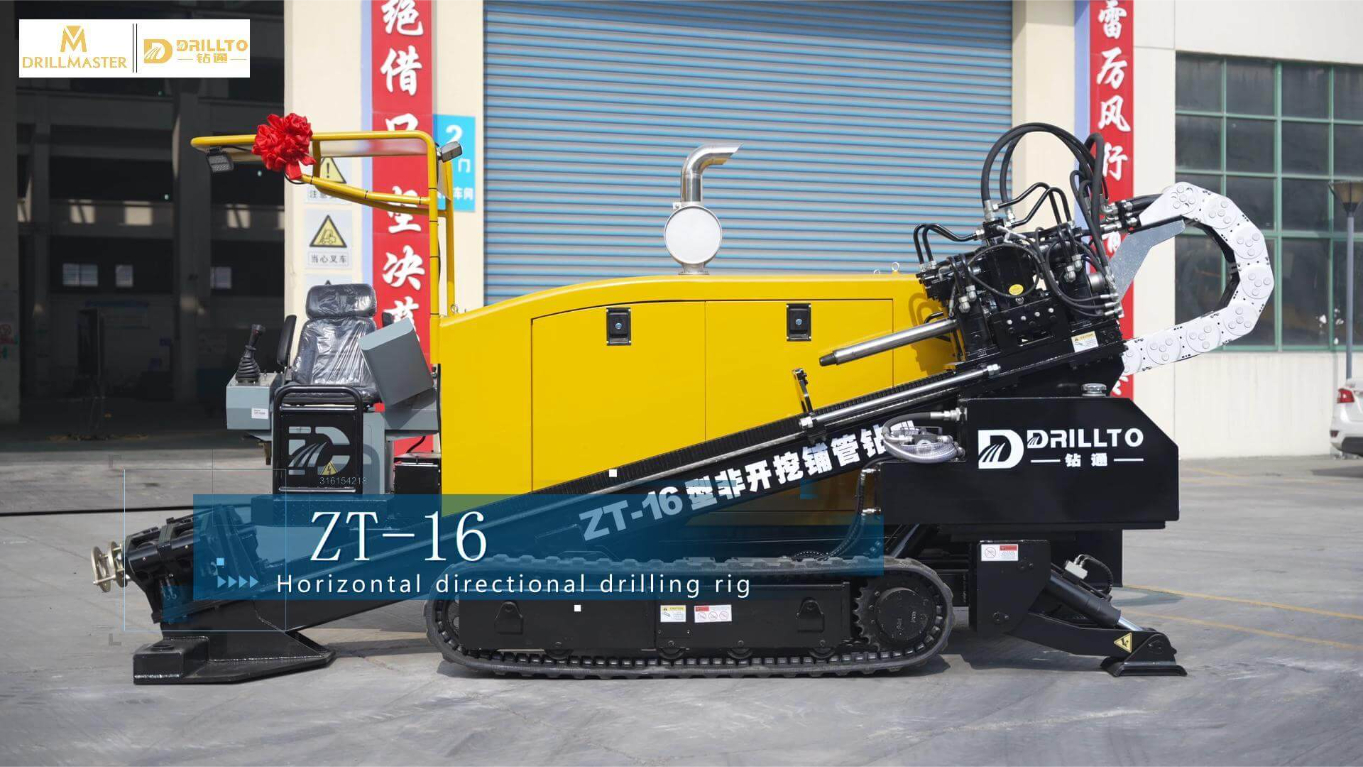
Mini drilling rigs (push-pull force: 60–500 kN): Typically used for short-distance, small-diameter projects such as water supply, power, and telecommunications. A representative model is the Zuantong ZT-16, designed with a focus on flexibility and cost-effectiveness, making it suitable for applications requiring high equipment mobility.
Medium-scale rigs (push-pull force: 500–2,000 kN): Suitable for projects such as natural gas pipelines.
Mega drilling rigs (thrust/pull force: 2,000–5,000 kN) and max drilling rigs (thrust/pull force: greater than 5,000 kN): Used for large-scale crossing projects, such as long-distance crossings over seas and rivers.
Key Factors for Model Selection
The precise selection of a horizontal directional drilling rig primarily depends on the following major factors:
1. Pipe Specifications
The larger the pipe diameter, the more exponentially the pullback resistance increases. Wall thickness and pipe weight are equally critical: for the same diameter, steel pipes are 3 to 5 times heavier than PE pipes, significantly increasing the push-pull force requirements during pullback.
2. Pipe Material Type
PE Pipes (Polyethylene Pipes): These offer good flexibility and allow for smaller bending radii, but their surface friction coefficient is relatively high; therefore, the drag-reducing effect of drilling mud must be considered during long-distance pullback.
Steel Pipe: Highly rigid, with limited bending radius; welded joints are prone to jamming, requiring greater stability in thrust and pull force during backhauling. Additionally, due to its heavy weight, a rig with ample thrust and pull force reserves must be selected.
3. Construction Distance (Maximum/Minimum)
The maximum crossing distance is the core indicator determining a drilling rig’s “operational range.” The minimum construction distance is often overlooked but is critical for small job sites.
4. Geological conditions
Geological conditions are the most critical variable in selecting a horizontal directional drilling rig. Requirements for the rig vary drastically depending on the formation. The rock and soil classifications in the geological survey report (loose soil layers, clay layers, sand layers, gravel layers, soft rock, hard rock) must be compared against the rig’s performance curves. For example, when encountering formations such as granite or limestone, a high-torque model must be selected. The Drillmaster AT All-Terrain Series (ZT-36AT/75/150AT), featuring proprietary all-terrain drilling technology, produces less mud leakage compared to traditional models and achieves higher drilling rates in rock formations.
5. Construction Site and Environment
Site conditions directly impact equipment selection and the feasibility of site access. In restricted spaces such as urban core areas and narrow alleys, priority should be given to compact, highly maneuverable small crawler-mounted drill rigs, while ensuring that equipment noise and emissions comply with local environmental regulations. In open rural areas or large-scale cross-country sites, size restrictions can be relaxed, but the load-bearing capacity of access roads, space for mud pits, and accessibility under extreme weather conditions must be assessed. In short, the site environment determines the maximum allowable size of the drill rig and the required support solutions. It is essential to conduct a site survey before selecting a model to avoid the awkward situation of equipment being unable to enter the site or operate effectively.
Other Considerations
1. Power Source and Environmental Compliance
As environmental policies become stricter, low-emission engines have become standard. When making a purchase, verify that the equipment meets China V emission standards.
2. Brand Selection and After-Sales Service
The leading brands in China’s horizontal directional drilling rig market each have their own strengths: for example, Drillmaster offers first-class pre-sales, during-sales, and after-sales service, uses high-quality materials, and provides rapid customization. When selecting a model, we recommend prioritizing the capabilities of local service providers to ensure quick access to spare parts and technical support in the event of a malfunction.
Selecting a horizontal directional drilling rig is an art of balance—finding the optimal combination of project requirements, geological conditions, equipment performance, and budget. There is no “one-size-fits-all” drill rig; there is only the “most suitable” one. We recommend contacting multiple manufacturers to obtain detailed technical manuals and conducting on-site visits to observe the actual performance of similar projects before making a decision. Choosing the right horizontal directional drilling rig not only determines the success or failure of the current project but also shapes the boundaries of your company’s ability to undertake future projects.