


In Horizontal Directional Drilling (HDD) trenchless pipeline construction, the reaming process following the completion of the pilot bore is a critical step that determines construction efficiency, borehole quality, and the ultimate success rate of pullback.
As a key piece of drilling equipment that directly interacts with the formation, the proper selection of a reamer directly impacts: reaming speed; the drilling rig’s torque and thrust/pullback requirements; borehole wall stability; tool service life; and overall project construction costs.
Currently, the two most widely used types of reamers in HDD projects are: PDC reamers and Roller Cone Hole Openers.
Although both are used to enlarge the diameter of the pilot bore, they differ significantly in their rock-cutting mechanisms, structural designs, and suitable formations.
Simply put: PDC reamers rely on fixed cutting teeth to continuously shear the formation; roller cone hole openers rely on rotating roller cones to generate impact, crushing, and fragmentation effects. Therefore, in actual HDD projects, there is no single hole opener suitable for all formations.
The correct approach is to comprehensively select the appropriate HDD hole-opening tool based on geological conditions, rock strength, abrasiveness, borehole diameter requirements, and construction costs.
Differences in Operating Principles Between PDC reamers and Roller Cone Hole Openers
1. Traditional Roller Cone Hole Openers: Rotational Impact and Crushing Rock Fracturing
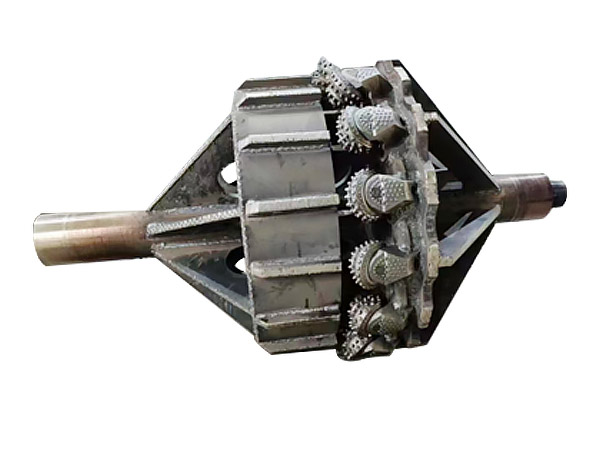
Traditional roller cone hole openers typically consist of multiple rotating roller cones. During construction, the drilling rig provides rotational power and axial pressure, causing the roller cones to roll along the borehole wall. The teeth on the rollers are in constant contact with the rock, generating cracks and producing cuttings through impact, compression, and localized fracturing.
The interior of a roller cone hole opener typically includes a roller assembly, a bearing system, a sealing structure, and a lubrication system. This design provides strong impact resistance, making it particularly suitable for hard rock, highly abrasive rock formations, and complex formations containing pebbles or boulders.
2. PDC reamer: Continuous Shear Rock Cutting
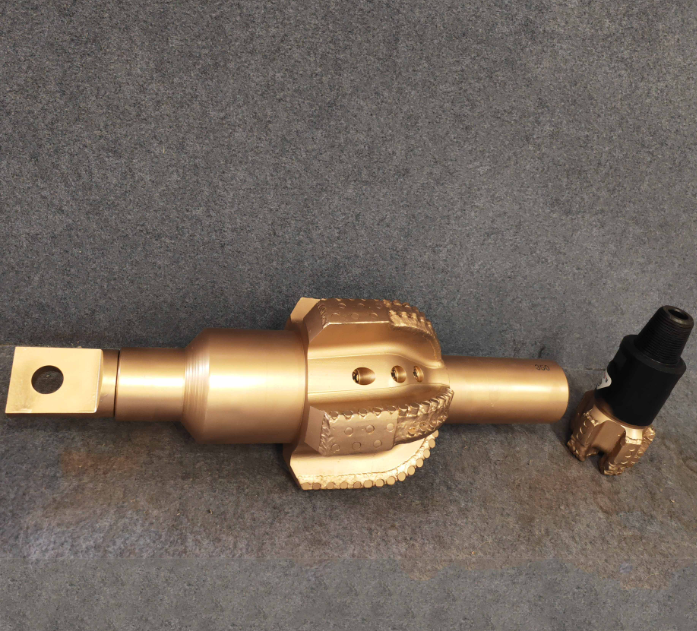
The PDC reamer employs a fixed cutter blade design, with polycrystalline diamond compact cutters mounted on the blade surfaces. During drilling, the PDC cutters maintain continuous contact with the formation, generating shear forces through high-speed rotation to cut away rock and soil layer by layer.
Unlike roller cone hole openers, PDC reamers typically lack rotating cones, bearing systems, and complex sealing structures. Their rock-cutting mechanism is similar to that of machining. Advantages include a continuous rock-cutting process with minimal torque fluctuations, a simple mechanical structure, and easier maintenance.
Key Difference: PDC reamers primarily cut rock through “shearing,” while roller cone hole openers primarily break rock through “impact and crushing.”
Five Key Differences Between PDC Reamers and Roller Cone Reamers
1. Structural Design Differences: Fixed Cutter Wings vs. Rotating Roller Cones
Structural Features of PDC Reamers
PDC reamers primarily consist of: a high-strength steel body; fixed cutter wings; PDC composite cutting teeth; and a chip-removal structure. Since they lack rotating components, their structure is simpler.
Key Advantages: No risk of bearing failure; no issues with wear on rotating seals; high overall reliability; simpler routine maintenance.
However, it should be noted that in environments with strong impact and highly abrasive hard rock, PDC composite inserts may experience wear, tooth breakage, and a decline in cutting performance.
Structural Features of Traditional Roller Cone Reamers
Roller cone reamers primarily consist of: a central shaft; a reamer body; rotating roller cones; bearings and a sealing system.
Advantages: High impact resistance; good adaptability to complex rock formations; ability to select different roller cone configurations based on formation conditions.
Disadvantages: Due to the presence of rotating components, they are subject to long-term effects such as mud ingress, sand abrasion, and impact loads.
Bearings and sealing systems are typically key factors affecting service life.
2. Differences in Formation Adaptability: The Core Factor in Selection
PDC reamers are typically suitable for: clay layers; sandy soils; mudstone; shale; weathered rock; and moderately soft, homogeneous rock formations. In particular, they can achieve high cutting efficiency in formations that are continuous, have uniform lithology, and exhibit low abrasiveness.
Advantages: Fast reaming speed; stable torque; good borehole wall quality. Rock-bit reamer suitable formations
Traditional roller cone reamers are generally better suited for: granite; basalt; hard sandstone; highly abrasive rock formations; gravel layers and formations with boulders.
Since roller cones use a rolling rock-breaking mechanism, they offer better adaptability to: hard rock; irregular rock formations and high-impact environments.
Important Notes: The actual selection must still take into account: rock compressive strength; abrasiveness; formation integrity; and the drilling rig’s torque capacity.
3. Differences in Reaming Efficiency, Torque, and Operational Stability
PDC Reamers
In suitable soft to medium-hard formations, PDC reamers typically achieve higher mechanical drilling speeds.
Main reasons: Continuous cutting reduces repeated fracturing; high cutting efficiency; and better energy utilization.
Operational characteristics: Torque variations are relatively smooth; vibrations are minimal; more uniform borehole walls; facilitates subsequent pipe pullback. However, when encountering: large isolated boulders; high-hardness interlayers; highly abrasive rock; cutting resistance may increase significantly.
Rolling Cone Reamers
Rolling cone reamers fracture rock through rolling impact and offer distinct advantages in hard rock environments.
Characteristics: Strong impact resistance; better adaptability to complex formations; outstanding hard rock fracturing capability.
Disadvantages: Noticeable vibration during reaming; torque fluctuations may be greater; bearing condition affects operational stability.
4. Differences in Service Life, Maintenance Methods, and Total Cost
Service Life and Cost Characteristics of PDC Reamers
Since PDC reamers eliminate the rotating bearings and sealing systems found in traditional roller cone reamers, their primary wear areas are concentrated in: PDC composite segments; cutting wing surfaces; and the tool’s outer diameter protection structure.
Under suitable formation conditions, PDC reamers typically exhibit good durability. Maintenance methods primarily include: replacing worn cutting wings; repairing cutting teeth; welding on wear-resistant materials; and inspecting the condition of the cutting wings.
Compared to traditional roller cone reamers, PDC reamers reduce the risk of unexpected downtime caused by bearing damage or seal failure. Therefore, in suitable HDD construction environments, their comprehensive cost per unit of advance is typically more advantageous.
Service Life and Cost Characteristics of Roller Bit Reamers
The performance of roller bit reamers is highly dependent on: roller wear; bearing life; seal reliability; and the degree of formation impact.
In hard rock and complex formations, roller bit reamers offer irreplaceable advantages.
However, due to the presence of rotating components, the following issues may arise during long-term use: bearing wear; seal failure; roller jamming and tooth wear or damage.
These issues may lead to: reduced reaming efficiency; increased tool maintenance costs; and extended drilling cycles.
Key distinction: PDC reamers offer the advantages of simple structure and easy maintenance; roller cone reamers excel in their adaptability to complex hard rock environments.
5. Comparison of Drilling Risks
Major Risks of PDC Reamers
PDC reamers lack rotating roller cones, so they are free from traditional risks such as: roller cone detachment; bearing failure; loss of rotating components; and other traditional risks.
The main risks stem from: sudden encounters with hard rock; impact from isolated boulders; and abnormal wear of PDC inserts.
Main Risks of Roller Cone Hole Openers
The greatest risk associated with roller cone hole openers stems from their rotating structure.
After prolonged operation: seal performance degrades; mud enters the bearings; bearing damage occurs; and roller cone failure may result. In severe cases, debris may fall into the borehole, increasing the difficulty of subsequent remediation.
Comparison Table: PDC reamervs. Roller Cone Hole Opener
| Comparison Item | PDC reamer | Roller Cone Hole Opener |
| Rock Breaking Method | Continuous shearing with fixed PDC cutters | Impact crushing and compression by rotating roller cones |
| Structural Design | Fixed blades without rotating components | Roller cones with bearings and sealing system |
| Mechanical Complexity | Simple structure | More complex structure |
| Torque Performance | Stable torque and smoother operation | Higher torque fluctuations |
| Vibration Level | Low vibration during reaming | Higher vibration due to impact crushing |
| Borehole Quality | Produces a smoother and more uniform borehole | Provides strong gauge protection and borehole stability |
| Suitable Formations | Clay, soil, mudstone, shale, and medium-soft rock formations | Hard rock, cobbles, gravel, and highly abrasive formations |
| Key Advantages | High efficiency, low maintenance, and stable cutting performance | Excellent impact resistance and adaptability in complex formations |
| Main Risks | Cutter damage under severe impact or highly abrasive conditions | Bearing, seal, and roller cone failures |
| Total Cost Efficiency | Lower cost per meter in suitable formations | Better economic performance in challenging hard rock conditions |
How to Choose Between a PDC reamerand a Roller Cone Hole Opener in HDD Operations?
The selection of hole opener tools cannot be simply determined by asking “which one is better.”
The correct approach is to select the most suitable hole opener based on formation conditions.
1. Situations Where PDC reamers Are the Preferred Choice
The following construction conditions are more suitable for PDC reamers:
(1). Formations consisting primarily of soft to medium-hard rock
For example: clay; sand layers; mudstone; shale; weathered rock.
(2). Projects prioritizing construction efficiency
If the project focuses on shortening the construction cycle, increasing reaming speed, or reducing equipment downtime, PDC reamers typically offer advantages.
(3). High requirements for borehole wall quality
For example: long-distance pipeline crossings; large-diameter pipeline pullbacks; projects sensitive to pullback resistance.
(4). Desire to reduce tool maintenance risks
PDC reamers have a simple structure, which can reduce the risk of downtime caused by rotating component failure.
2. Situations Where Roller Cone Hole Openers Are Preferred
The following situations are more suitable for roller cone hole openers:
(1). Hard rock and highly abrasive formations
For example: granite; basalt; hard sandstone.
(2). Complex formations containing large amounts of cobbles or boulders
Due to drastic formation variations, the impact rock-breaking method of roller cones is typically more stable.
(3). Long-distance rock-penetration projects
Especially: HDD projects with complex geological conditions and high risk control requirements.
Recommendations for Selecting HDD Hole Openers: Do Not Overlook Geological Conditions
In actual projects, the selection of reamers should comprehensively consider the following factors:
Formation Type: It is necessary to clarify: the proportion of soil layers; rock types; rock hardness; and abrasiveness.
Reaming Diameter: Large-diameter reaming typically requires: a stronger tool structure; better cuttings removal capability; and a reasonable blade design.
Drilling Rig Capabilities: Including: torque; thrust and pull force; and mud circulation capacity.
Construction Objectives: For example: prioritizing speed; prioritizing stability; reducing risks; controlling costs.
Combined Reaming Solutions in HDD Projects
In certain complex formations, it is not always necessary to use only a single type of reamer. Combined solutions are commonly adopted on-site:
For example:
Phase 1: Use a roller cone reamer to penetrate hard rock sections;
Phase 2: Use a PDC reamer to complete the subsequent borehole enlargement.
Alternatively, depending on variations in formation conditions, different types of reamers may be combined for construction.
This approach balances construction efficiency, tool life, and project safety.
HDDMaster Professional Reamer Solutions
HDDMaster specializes in the manufacturing of horizontal directional drilling tools, providing customized reaming solutions for various geological conditions.
Our HDD reamer designs take into account formation characteristics, reaming diameter, rig parameters, project distance, and construction environment.
Product solutions include: PDC reamers; HDD Rock Reamers, Customized Hole Openers, and HDD Drilling Tools.
To meet specific project requirements, we offer: optimized PDC cutting wing designs; roller bit configuration; wear-resistant structural designs; and solutions for special formations.
If you are undertaking an HDD project and are unsure whether to choose a PDC reamer or a roller bit hole opener, you can refer to: geological reports; hole enlargement dimensions; rig models; project distance; to obtain more accurate tool selection recommendations.
Frequently Asked Questions (FAQ)
1. What is the difference between a PDC hole opener and a roller cone hole opener?
A PDC hole opener uses fixed PDC cutters to continuously shear the formation, while a roller cone hole opener uses rotating cones to crush rock through impact and compression.
PDC tools are usually preferred for soft to medium formations, while roller cone tools perform better in hard and abrasive formations.
2. Which HDD reamer is better for rock drilling?
There is no universal answer.
The best HDD reamer depends on:
· Rock hardness
· Formation type
· Abrasiveness
· Drilling rig capacity
· Project requirements
PDC hole openers are often suitable for homogeneous soft-to-medium formations, while roller cone hole openers are commonly selected for hard rock conditions.
3. Can a PDC hole opener be used in hard rock?
It depends on the rock properties.
PDC hole openers can work in some medium-hard formations, but highly abrasive rock, large cobbles, and strong impact conditions may accelerate cutter damage.
4. How do I select the right HDD hole opener?
The selection process should consider:
· Geological conditions
· Required hole diameter
· Drilling rig torque
· Pullback requirements
· Expected drilling cost
Professional tool selection can significantly reduce construction risks and improve project efficiency.
PDC reamers and Roller Cone Hole Openers Are Not Mutually Exclusive but Rather Complementary Based on Formation Characteristics
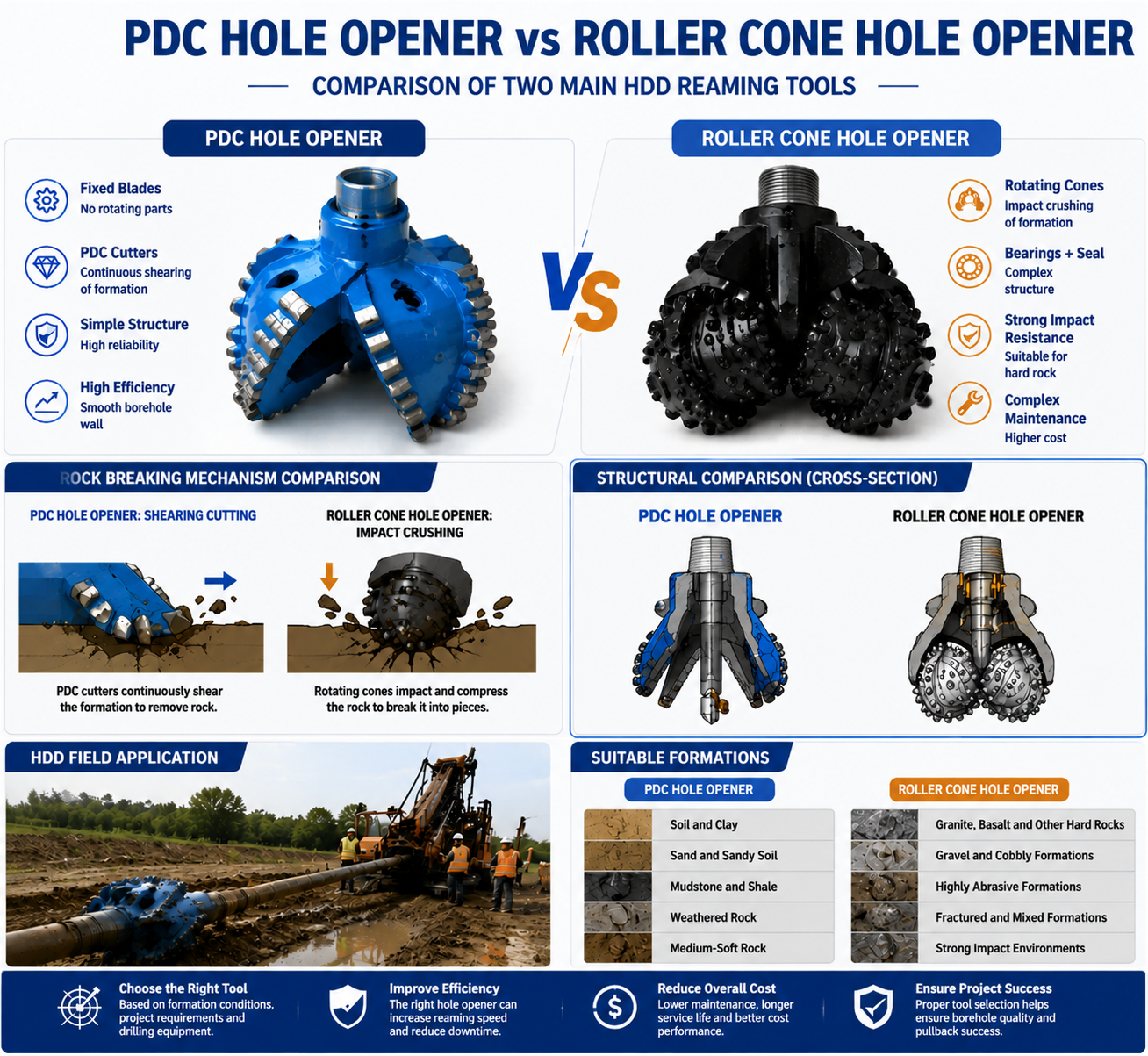
PDC reamers and traditional roller cone hole openers each have their own advantages. PDC reamers, with their continuous cutting action, simple structure, easy maintenance, and high hole-opening efficiency, offer significant advantages in HDD operations in soft to medium-hard homogeneous formations.
Roller cone hole openers, with their strong impact resistance, adaptability to complex formations, and hard rock fracturing capability, remain an important choice for hard rock and highly abrasive formations.
For any HDD project, the best hole opener is not the most expensive tool, but the one best suited to the current formation conditions.
By selecting the appropriate PDC reamer or roller cone hole opener, you can effectively improve construction efficiency, reduce tool wear, and control overall project costs.