


In horizontal directional drilling (HDD) projects, drill rod failure is one of the most costly and frustrating problems contractors face.
A broken drill rod can lead to:
· Unexpected downtime and project delays;
· Difficult pipe recovery operations;
· Increased equipment maintenance costs;
· Higher risks of stuck pipe and failed bore projects.
Many contractors assume that frequent drill rod failures are simply caused by poor pipe quality.
However, in real HDD operations, drill rod damage is usually the result of multiple factors, including excessive loads, improper tooling selection, and insufficient maintenance.
So why do HDD Drill Rods break frequently?
This article explains the three major causes of HDD drill rod failure and how contractors can reduce the risk of unexpected damage.
Excessive Operating Loads: Exceeding the Drill Rod’s Capacity
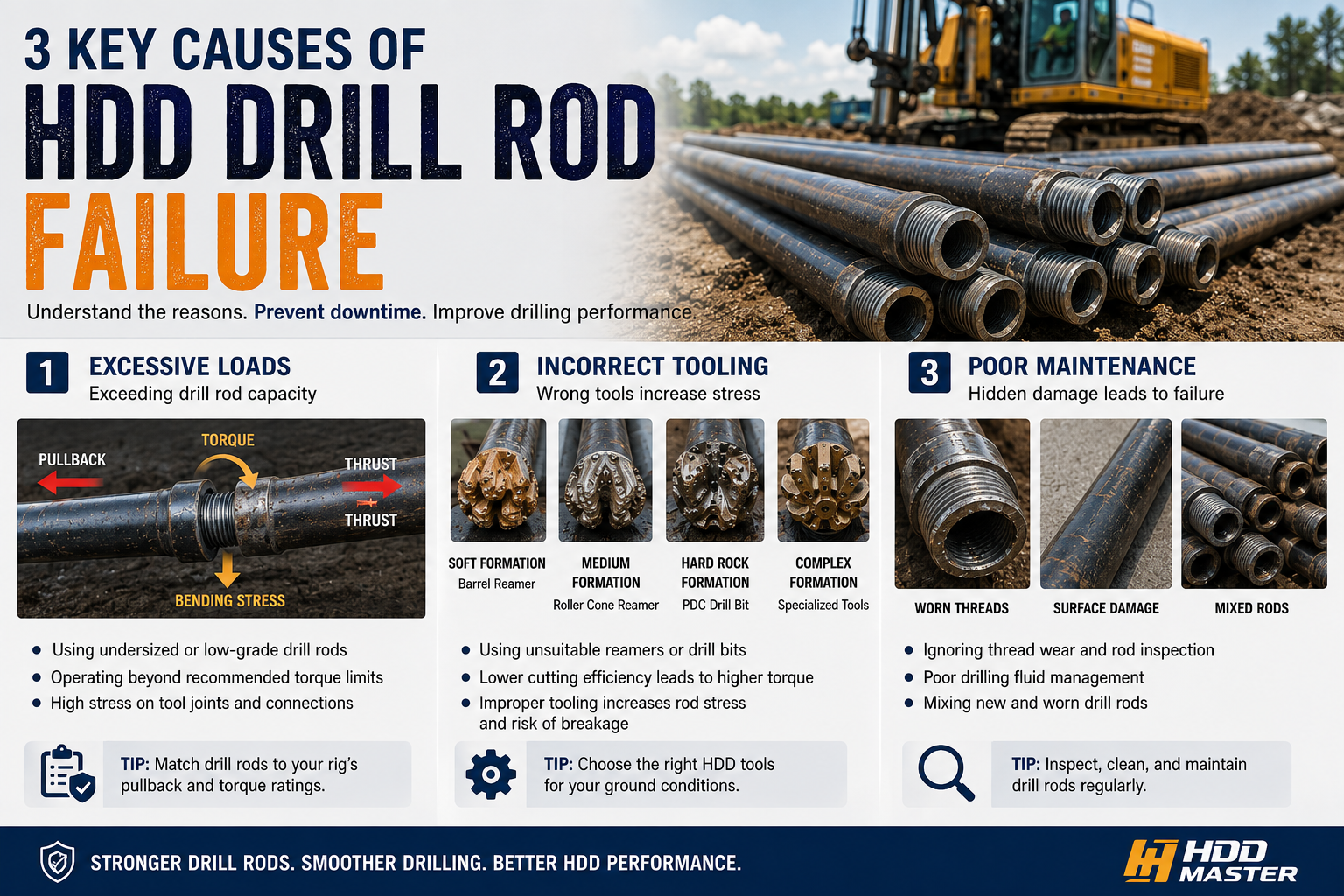
One of the most common reasons for HDD drill rod failure is excessive mechanical stress.
During horizontal directional drilling, drill rods are constantly exposed to:
· Pullback force;
· Torque;
· Bending stress;
· Ground resistance.
When the applied forces exceed the pipe’s designed capacity, fatigue damage gradually develops inside the pipe.
Eventually, this can result in:
· Thread damage;
· Pipe deformation;
· Tool joint failure;
· Complete pipe breakage.
Using Undersized Drill Rods for Heavy-Duty Applications
To reduce operating costs, some contractors use smaller or lower-strength drill rods for demanding projects.
Typical examples include:
· Using small-diameter drill rods for large-diameter bores;
· Using standard pipes in hard rock formations;
· Operating beyond recommended torque limits.
Although the pipe may work initially, repeated overload conditions accelerate fatigue and shorten service life.
Running at Maximum Torque for Extended Periods
During hard rock drilling, insufficient cutting efficiency can cause operators to continuously increase torque output.
The highest stress usually occurs around:
· Pin connections;
· Box connections;
· Welded transition areas.
These areas are often the first locations where drill rod failure occurs.
How to Prevent Excessive Load Damage
✔ Select drill rods that match your HDD rig specifications;
✔ Avoid continuous operation at maximum torque levels;
✔ Choose suitable drill bits and reamers based on ground conditions;
✔ Regularly inspect drill rod wear and fatigue conditions.
Difficult Ground Conditions: Incorrect Tool Selection Increases Pipe Stress
Many HDD drill rod failures are actually caused by improper tooling selection.
Different geological conditions require different drilling solutions.
For example:
| Ground Condition | Common Challenges |
| Clay | Poor cuttings removal and increased resistance |
| Sand | Borehole instability and higher pullback force |
| Gravel | Increased impact loads |
| Hard Rock | Higher torque requirements |
When the wrong drilling tools are used, cutting efficiency decreases.
The result is:
Improper tooling → Higher drilling resistance → Increased torque → Excessive pipe stress → Drill rod failure
Choosing the Right HDD Tools for Different Formations
For example:
Using a standard cutting reamer in hard rock formations may significantly reduce drilling efficiency.
Operators may compensate by increasing:
· Rotation torque;
· Push force;
· Pullback pressure.
This places additional stress on the drill string.
Selecting the correct HDD tooling can significantly reduce unnecessary loads.
Common choices include:
· Barrel Reamers and Fluted Reamers for softer formations;
· Roller Cone Reamers for medium to hard formations;
· PDC Drill Bits and rock drilling tools for challenging rock conditions.
Poor Maintenance: Hidden Damage Leads to Sudden Failure
Many contractors only pay attention when a drill rod breaks.
However, HDD drill rods experience fatigue throughout their service life.
Every drilling operation can cause:
· Thread wear;
· Surface damage;
· Metal fatigue;
· Internal micro-cracks.
These problems may not be visible initially but can eventually lead to sudden failure.
Common Drill Rod Maintenance Mistakes
1. Ignoring Thread Inspection
The threaded connection area carries significant torque and pulling forces.
Damaged threads caused by:
· Wear;
· Deformation;
· Cracks;
can eventually lead to connection failure.
2. Poor Drilling Fluid Management
Drilling fluid plays an important role in:
· Cooling;
· Lubrication;
· Cuttings removal.
Incorrect mud properties can increase:
· Friction;
· Borehole resistance;
· Drill rod loading.
3. Mixing New and Worn Drill Rods
Drill rods with different service histories have different strength levels.
Combining heavily worn pipes with new pipes may create weak points in the drill string.
How to Extend HDD Drill Rod Service Life
To minimize drill rod failures, contractors should establish a proper management system.
Select the Correct Drill Rod
Consider:
· HDD rig specifications;
· Maximum pullback force;
· Maximum torque;
· Bore length;
· Ground conditions.
Choosing the correct pipe size and strength rating is essential.
Control Drilling Parameters
Avoid:
❌ Continuous operation above recommended torque limits
❌ Forcing the drill string through excessive resistance
❌ Using unsuitable tools for difficult formations
Establish Regular Inspection Procedures
Before drilling, check:
· Thread condition;
· Pipe straightness;
· Surface damage;
· Connection wear.
After drilling:
· Clean and inspect for drill rods with severe wear.
· Check the threaded sections for seized threads.
· Check the threads for damage.
· Sort and store them.
Drill Rod Failure Is Preventable
Frequent HDD drill rod failures are usually not caused by a single problem.
The three main causes are:
· Excessive operating loads;
· Incorrect tooling selection for ground conditions;
· Lack of proper inspection and maintenance.
By selecting high-quality drill rods, using suitable HDD tooling, and following proper operating procedures, contractors can significantly reduce downtime and improve drilling efficiency.
HDDMaster provides HDD drill rods, drill bits, reamers, and trenchless drilling solutions designed to help contractors improve reliability and reduce equipment downtime.
Frequently Asked Questions (FAQ)
1. How often should HDD drill rods be replaced?
There is no fixed replacement cycle. Service life depends on drilling conditions, torque loads, operating practices, and maintenance quality.
2. Why do HDD drill rods usually break at the connection?
The threaded connection area experiences the highest torque and tensile stress, making it more vulnerable to fatigue damage.
3. How can contractors reduce drill rod damage in hard rock drilling?
Use proper rock drilling tools, improve cutting efficiency, and avoid prolonged operation under excessive torque.
Click To Konw More About Drill Rod: Common Causes and Solutions for HDD Drill Pipe Failure