


You’re planning a water pipeline project. Maybe it’s a new water main for a growing neighborhood. Maybe you’re replacing an old line that keeps bursting. Or maybe you need to connect two systems across a river.
The big question: Should you dig a trench, or use Horizontal Directional Drilling (HDD)?
HDD sounds fancy – and yes, it’s high-tech. But it’s not always the right answer. Sometimes open-cut trenching makes more sense. Other times, HDD is the clear winner.
Let’s look at six scenarios where HDD is absolutely the better choice for your water pipeline. No engineering degree required.
1. When Your Water Pipeline Needs to Cross a River or Wetland
The problem: Rivers and wetlands are protected for a reason. They’re home to fish, birds, and plants. Digging through them stirs up mud, damages habitats, and often requires permits that take years to get. Some crossings are simply off-limits for open-cut construction.
Why HDD wins: Your water pipeline goes under all that. Way under. Drilling rigs can place pipe 60, 80, even 100 feet below a riverbed. The water keeps flowing. The fish keep swimming. The wetland stays wet. Nobody knows you were there.
Real-world example: In North Carolina, Charlotte Water needed to install a new water pipeline across the Catawba River. This isn’t just any river – it’s home to bald eagles, ospreys, and rare Rocky Shoals Spider Lilies. Open-cut was out of the question.
They used HDD to drill 65 feet beneath the river. The pipeline now carries millions of gallons of water daily. The eagles? Still fishing. The lilies? Still blooming. You’d never know there’s a massive pipe down there .
2. When Your Water Pipeline Must Go Under a Busy Road, Highway, or Railroad
The problem: Closing lanes on a major highway costs thousands per hour in traffic control – and that’s before you count the angry commuters. Shutting down a rail line? Often not even allowed. Trains need to keep running.
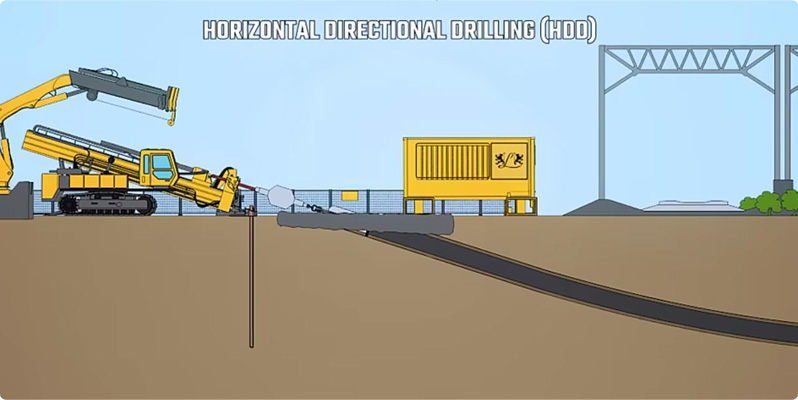
Why HDD wins: You drill under the traffic. Cars and trains never stop. No detours, no flaggers, no late-night lane closures. Just a small entry pit on one side and an exit pit on the other. Everything in between stays normal.
Real-world example: In Adelaide, Australia, SA Water needed to install massive 1200mm water mains – that’s nearly four feet in diameter – under an active rail line. Open-cut would have meant shutting down trains for days or weeks.
With HDD, they installed a 36-meter sleeve under the tracks while trains kept running overhead. Commuters never knew it happened. The South Australian government noted that without these new pipes, the network would hit capacity and new homes couldn’t be built.
3. When the Ground Is Already Packed With Other Utilities
The problem: Under most city streets, it’s a jungle down there. Gas lines, electric cables, fiber optics, sewer pipes, old water lines – sometimes nobody even knows exactly what’s where. Digging with an excavator is like playing roulette. One wrong scoop and you’ve got a gas leak, a blackout, or a massive fine.
Why HDD wins: HDD is precise. Modern guidance systems keep the drill head on target within inches. You can weave your new water pipeline between existing utilities without touching them. It’s like threading a needle underground.
Real-world example: The record-breaking James River crossing in Virginia used gyroscopic steering tools on drills approaching from opposite sides of the river. They met 100 feet below the riverbed within inches of their target. That kind of precision saves millions in avoided utility damage.
4. When You Want to Avoid Traffic Jams, Noise Complaints, and Angry Neighbors
The problem: Open-cut construction turns neighborhoods into obstacle courses. Businesses lose customers because nobody can park. Residents deal with weeks of noise, dust, and detours. The “social cost” isn’t in your budget, but you’ll hear about it at every city council meeting.
Why HDD wins: Most of the work is underground. Surface disruption is minimal – just a small pit at each end. Shops stay open. Traffic keeps moving. Neighbors barely notice. You finish the project without making enemies.
Real-world example: In Glenbrook, New Zealand, Watercare needed to replace water pipelines under an estuary – a beautiful coastal area residents love. Instead of tearing up the shoreline, they drilled 15–20 meters beneath the seabed.
The project cost $6.3 million and installed three pipelines serving 357 homes. Local residents got modern infrastructure without their beach looking like a construction zone. The project manager noted they “reduced soil disturbance and environmental erosion” by going under instead of through.
5. When You Want to Save Money Over the Life of the Project
The problem: Open-cut looks cheaper on paper. Digging is straightforward. But the hidden costs add up fast: repaving roads, repairing damaged utilities, traffic control crews, environmental mitigation, lawsuits from affected businesses. Suddenly that “cheaper” option isn’t so cheap.
Why HDD wins: Yes, the upfront cost per foot can be higher. But the total installed cost – including everything – is often lower. Plus, HDPE pipe installed via HDD lasts longer because it’s buried deeper, protected from surface traffic, frost, and corrosion.
Real-world example: The James River project saved nearly $10 million by choosing HDD over the original plan. How? They eliminated an expensive in-water construction platform, avoided environmental fines, and didn’t have to restore riverbed habitat. One design change, millions in savings.
6. When You’re Installing Large-Diameter Water Pipelines That Need to Last 50+ Years
The problem: Big water pipelines – 24 inches, 36 inches, 48 inches – are critical infrastructure. They need to last generations. Jointed pipes have potential leak points at every connection. And if they’re not buried deep enough, they’re vulnerable to traffic loads and freezing.
Why HDD wins: HDD works beautifully with HDPE pipe – flexible, corrosion-resistant plastic that gets fused into one continuous length. No joints means no leaks. And because HDD places pipe deep underground, it’s protected from whatever happens on the surface.
Real-world example: The James River project used 42- to 54-inch HDPE pipe – among the largest ever installed via HDD. The pipe was pulled in one continuous piece, creating a seamless, leak-proof water tunnel under the river. Engineers used a custom-built $1 million pipe pusher from Germany to handle the massive pull forces.
When Should You Not Use HDD for Your Water Pipeline?
Let’s be honest: HDD isn’t always the answer. Skip it when:
- You’re in an open field with no obstacles. Just dig. It’s faster and cheaper.
- The ground is full of boulders. Drilling through rock piles is risky and expensive.
- You need very shallow pipe. HDD needs enough cover to prevent the drill from breaking the surface.
- The site is too tight for equipment. Those drilling rigs are big. Sometimes there’s just no room.
- So when is HDD the clear winner for your water pipeline project?
Ask yourself these questions:
- Am I crossing a river, wetland, or other sensitive area?
- Do I need to go under a busy road or active railroad?
- Is the ground already crowded with other utilities?
- Do I want to avoid disrupting traffic and annoying residents?
- Could the long-term savings outweigh the upfront cost?
- Am I installing a large-diameter pipeline that needs to last?
If you answered “yes” to any of these, HDD deserves a serious look.
The proof is in projects around the world – from the Catawba River in North Carolina to the James River in Virginia, from Adelaide’s rail lines to New Zealand’s estuaries. In the right scenarios, HDD delivers cheaper, faster, and friendlier results.
And in many cases, it’s the only way to get the job done at all.
Want to talk through your specific project? Contact us for a plain-English consultation on whether HDD is right for your water pipeline.