


As urban underground pipeline networks become increasingly dense, Horizontal Directional Drilling (HDD) has emerged as one of the most essential trenchless construction technologies. It enables the precise installation of gas, water, power, and telecommunication pipelines without large-scale road excavation, and is widely used in municipal renovations, long-distance transmission lines, and environmental projects.
What is HDD?
Horizontal Directional Drilling (HDD) is a trenchless method used for installing underground pipes, conduits, and cables in a shallow arc along a prescribed bore path by using a surface-launched drilling rig. This technique is widely used for the installation of utility lines (water, gas, electrical, telecommunications) beneath obstacles such as roads, rivers, and buildings.
Main Components of HDD Equipment
A complete HDD system comprises the following key components working in synergy:
| Component | Function |
| Drilling Rig | Core power source providing rotational torque and thrust/pullback force to drive the drill pipe. |
| Drill Rods | High-strength hollow steel pipe that transmits drilling fluid, mechanical force, and connects the drill bit. |
| Drill Bit | Cutting tool at the front end, selected according to geology (e.g., roller cone, PDC) to break soil or rock. |
| Drilling Fluid (Mud) | A mixture of water + bentonite or polymers that cools the bit, suspends and carries cuttings, stabilises the borehole, and reduces friction. |
| Reamer | A tool used after pilot hole completion to enlarge the borehole stepwise to the required diameter (e.g., eccentric or conical reamers). |
| Probe (Transmitter) | Housed near the drill bit, it transmits real-time signals (azimuth, inclination, depth) for surface receivers to locate and guide the bit. |
| Mud Recycling System | Includes shakers, desanders, and centrifuges to purify returned mud for reuse, lowering costs and environmental risks. |
Standard HDD Construction Procedures
HDD construction is typically carried out in four consecutive stages:
Planning & Design
· Site survey and underground utility detection to assess feasibility;
· Design the drill trajectory (entry/exit angles, radius of curvature, cover depth);
· Prepare a detailed construction plan, contingency measures, and mud management strategy.
Pilot Hole Drilling
Drill a small diameter (50–150 mm) pilot hole along the designed path using a probe equipped bit;
Continuously monitor the bit position with surface tracking instruments and correct deviations to remain within allowable tolerances.
Reaming & Pullback Preparation
After the pilot hole is completed, connect a reamer at the exit side and enlarge the hole in multiple passes (typically to 1.2–1.5 times the pipe diameter);
The number of reaming passes depends on geology and pipe size; proper hole cleaning and mud circulation are maintained.
Pipe Pullback
Once reaming is complete, connect the prefabricated pipe (or casing) to the drill string at the exit end and pull it back to the entry end as a single assembly;
Continuously inject mud during pullback to reduce friction and prevent sticking, finalising the installation.
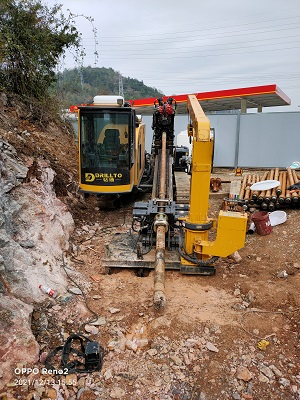
Core Advantages of HDD
Compared to conventional open-cut trenching, HDD offers significant overall benefits:
✅ Minimal surface disruption: Only two small working pits are needed; traffic, landscaping, and building foundations remain largely unaffected.
✅ Superior environmental performance: Reduces earth excavation and transport, lowers dust and noise; mud can be recycled, meeting green construction requirements.
✅ Strong obstacle-crossing capability: Easily crosses rivers, highways, railways, and existing underground structures.
✅ Better overall cost efficiency: In congested urban areas, reduced costs for demolition, traffic diversion, and surface restoration often make HDD more economical than open excavation.
Main Application Scenarios
HDD is widely used in the following fields:
· Municipal utilities – New construction and renewal of gas, water supply, sewage, heating, and power conduits;
· Telecommunications – Fibre optic and 5G cable installations;
· Environmental remediation – Groundwater monitoring wells and injection wells for pollution treatment;
· Long-distance oil & gas pipelines – Crossing large rivers, mountain ridges, and nature reserves.
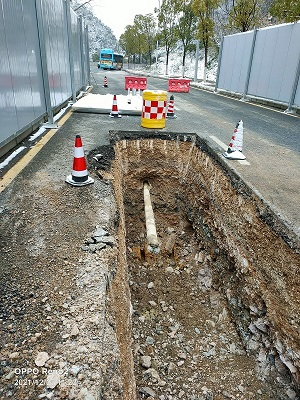
Construction Challenges and Key Control Measures
Despite its maturity, HDD faces several on-site challenges that require careful management:
| Challenge | Control Measures |
| Complex geology | Conduct thorough geotechnical investigation; select suitable bits and reaming techniques for soft soil, sand, gravel, or hard rock; adjust mud formulations. |
| Trajectory deviation | Use high-accuracy wireless probes + surface receivers; take readings per drill pipe and correct promptly; deploy wire-line guidance if needed. |
| Mud loss & disposal | Control mud pressure, add lost-circulation materials; install on-site recycling equipment; strictly prohibit unauthorised discharge and ensure compliant waste handling. |
| Equipment breakdown | Implement preventive maintenance schedules; regularly inspect drill pipe wear, hydraulic systems, and mud pumps; stock critical spare parts. |
| Excessive pullback resistance | Apply drag-reducing mud formulations; control reaming stages and final hole size; use lubricants or floating pullback methods when necessary. |
Summary and Recommendations
Horizontal Directional Drilling is a highly efficient, environmentally friendly, and precision-based trenchless technique that is reshaping underground pipeline construction. Successful HDD projects depend on rational trajectory design, reliable equipment selection, skilled operational crews, and strict mud management.
For project managers, thorough pre-construction site investigation, real-time monitoring during drilling, and standardised backfilling after installation are the three pillars of quality and safety. If you are planning a pipeline crossing through obstacles, HDD is certainly a technology route worth prioritising.