


In trenchless horizontal directional drilling (HDD) operations, a reamer is often simply viewed as a “tool for enlarging the borehole.” However, experienced professionals in crossing projects know that the correct selection and proper use of a reamer directly determine whether the project will suffer from borehole collapse or stuck-pipe incidents. Reamers play an irreplaceable, core role in preventing these issues; they are not merely tools for enlargement but serve as the first line of defense for safety throughout the crossing operation.
Reamer Selection: Mitigating Collapse Risks at the Source
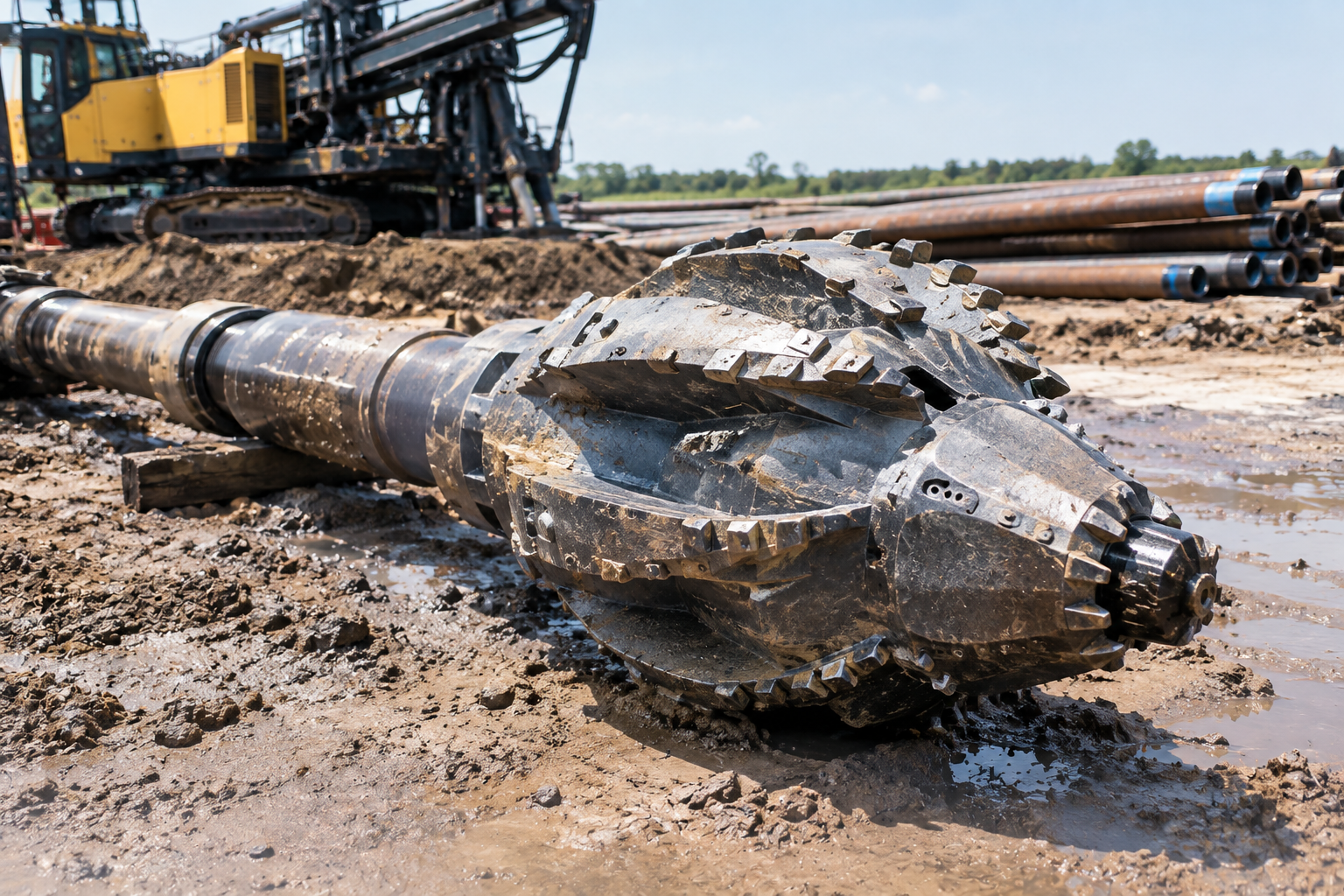
Choosing the Right Reamer Type: Establishing the Correct “Dialogue” with the Formation
Mechanical properties vary vastly across different geological formations; selecting the wrong reamer almost inevitably leads to borehole wall instability. Currently, four main types of reamers are used in trenchless engineering:
Compaction reamers enlarge the hole by compressing the formation and are suitable for soft soil layers;
flow-channel reamers combine compression with cutting and cuttings-removal capabilities, offering broad applicability;
cutting reamers rely primarily on a cutting action with efficient cuttings removal, making them particularly suitable for dense sandy soils;
and rock reamers come in two varieties—roller-cone and disc-cutter types—designed for soft rock and hard rock formations, respectively.
The logic behind selection is straightforward: use compaction reamers for soft formations, cutting reamers for dense sandy layers, and roller-cone or disc-cutter reamers for hard rock. If these are mismatched—such as using a compaction reamer in dense strata or a cutting reamer in loose backfill—the borehole wall fails to form a stable structure, making collapse merely a matter of time.
Reamer Sag and Gourd-Shaped Boreholes: Identifying the “Culprits” Behind Collapse
Many are unaware that the weight of the reamer itself is a critical factor causing borehole wall instability during the reaming process. Academic research indicates that due to the reamer’s weight, the cross-section of the reamed hole is rarely a perfect circle; instead, it often takes on a teardrop, pear, or even gourd-like shape. The likelihood of roof collapse in these non-circular holes is 138% higher than in circular ones.
How do “gourd-shaped” holes form? During the pullback process, the reamer continuously sinks as the reaming displacement increases; the amount of sinking at each stage equals the difference between the radius of the reamer at the previous stage and the radius of the drill pipe at the current stage, ultimately creating a characteristic “gourd-shaped” profile. Higher reaming speeds result in greater sinking, whereas increasing the rotational speed—within a certain range—actually reduces the sinking amount. This implies that the operational parameters of the reamer—specifically the balance between reaming speed and rotational speed—directly determine the stability of the hole’s shape.
The takeaway for operators is clear: preventing collapse requires more than just focusing on drilling fluid composition; precise control of reaming parameters is equally critical.
Anti-Stuck Design: A “Safety Catch” for Drilling Operations
Centralizing Structure and Bi-directional Cutting: Ensuring Freedom of Movement
Getting the tool stuck is one of the most troublesome issues in reaming operations. Traditional reamers, lacking reverse-cutting capabilities, are nearly impossible to retract once jammed. Modern anti-stuck reamers resolve this pain point through structural innovation.
A typical design features two sets of opposing roller cutters combined with a spiral centralizer. The two sets of cutters face opposite directions, enabling cutting and reaming in both directions; if the tool becomes stuck during pullback, it can be freed by rotating in reverse. The spiral centralizer serves a dual purpose: it clears debris and obstructions, pushing rock cuttings and fragments outward during the reaming process to minimize the risk of accumulation-induced jamming.
Furthermore, the centralizer offers an additional, less obvious benefit: it helps limit the reamer’s sinking by acting as a “positioning constraint” between the tool and the borehole wall, which also helps suppress the formation of gourd-shaped holes.
Staged Reaming and Hole Cleaning: A “Combined Strategy” for Preventing Stuck Tools
Optimizing the reamer’s structure is only half the battle against getting stuck; the other half lies in the coordination of operational techniques. Step-wise reaming is a fundamental requirement; the diameter difference between stages should ideally be controlled within the 100–150 mm range, though this can be increased for soft soil layers. If the span is too wide or the volume of material cut in a single pass is excessive, cuttings cannot be evacuated quickly enough, causing the reamer to easily become “bogged down” in the debris pile.
Borehole cleaning operations after each reaming stage are equally essential. If a single cleaning pass is insufficient, the process should be repeated two or three times to fully remove rubble and impurities. In rock formations particularly, the accumulation of cuttings is a primary cause of the reamer becoming stuck.
Operational Essentials: Maximizing the Reamer’s Performance
The true value of a reamer is realized during actual operation. Construction personnel should pay close attention to the following key points:
Regarding reaming parameters, drilling speed and rotation speed must be dynamically adjusted based on feedback from the formation. If torque fluctuates or pullback force increases abnormally, the first step should be to reduce drilling speed while slightly increasing rotation speed; this minimizes reamer subsidence, optimizes the borehole shape, and facilitates the removal of accumulated cuttings.
Regarding borehole stabilization, the mud used during the reaming phase should contain higher concentrations of wall-stabilizing agents and viscosifiers to enhance filter-cake formation and prevent borehole collapse or diameter shrinkage. In formations prone to collapse—such as sandy clay or loose fill—using solid-phase mud or high-viscosity solid-phase mud can effectively mitigate the risk of borehole collapse.
Regarding monitoring, trends in reaming torque and pullback force must be closely tracked during construction. If torque remains consistently high or pulling force spikes suddenly, do not force the pullback to continue; instead, retract the reamer slightly, increase the mud flow rate, and then resume pulling back slowly. This “step back before moving forward” strategy is often more effective at preventing stuck-tool incidents than simply powering through.
Returning to the initial question: why are reamers indispensable in trenchless engineering? The answer lies not merely in the reamer’s ability to enlarge the borehole; rather, the choice of reamer determines borehole wall stability, its structural design dictates whether the drilling assembly gets stuck, and its operating parameters determine whether the entire crossing operation can be completed safely. Hole collapse and getting the drill stuck are the two primary risks in horizontal directional drilling (HDD) projects, and the reamer is the critical piece of equipment for mitigating both. Only by selecting and utilizing the reamer correctly can the “safety baseline” of a trenchless project truly be upheld.