


A common and practical question arises on HDD job sites: is it acceptable to connect and use drill pipes of different diameters together? Situations like limited pipe inventory, unexpected changes in ground conditions, or transitioning between drilling phases can create a perceived need to mix pipe sizes. This article provides a clear, professional breakdown of the feasibility, risks, and strict requirements involved.
The Bottom Line Up Front:
While it is technically possible to connect large and small-diameter drill pipes in HDD operations, it is highly condition-dependent and generally not recommended for routine use. Drill strings are engineered systems designed to transmit thrust and torque while resisting formation pressures. Mixing sizes introduces potential weak points and performance issues that can compromise safety and efficiency.
1. The Critical Component: The Transition Sub
The feasibility of connecting different pipe sizes hinges not on the outer diameter, but on matching the power transmission interface. The key to a safe connection is a properly engineered transition sub (or reducer/increaser sub). This specialized adapter has threads on each end that match the specific thread type and size of the large and small drill pipes (e.g., connecting 3.5″ pipe to 4.02″ pipe).
A quality transition sub is forged from high-strength alloy steel and heat-treated to match the drill pipe’s mechanical properties. Its primary functions are to:
- Transfer full rig loads (thrust/torque) without failure.
- Maintain a pressure-tight seal to prevent drilling fluid leaks, which is critical for hole stability and tool lubrication.
Crucial Note: The sub must exactly match the thread standard (e.g., API, proprietary double-shoulder) of both pipes. “Close enough” is not acceptable and will lead to connection failure.
2. Three Non-Negotiable Prerequisites for a Safe Connection
Even with the correct sub, a connection is only viable if all three conditions are met:
- Strength Compatibility: The smaller-diameter pipe must be rated for the maximum anticipated thrust and torque of the entire job. It becomes the weak link in the load path. Exceeding its yield strength can cause deformation or catastrophic failure.
- Operational Phase Suitability: Mixing pipes is only considered during non-steering phases, such as reaming or product pullback. It is strongly discouraged during pilot hole drilling. The difference in bending stiffness between sizes makes accurate steering difficult and can lead to unintended trajectory deviation.
- Proper Make-up Procedure: The connection must be made to specification. This requires clean, undamaged threads, the correct thread compound, and torquing to the manufacturer’s specified value. Under- or over-torquing can cause leaks, thread damage, or fatigue points.
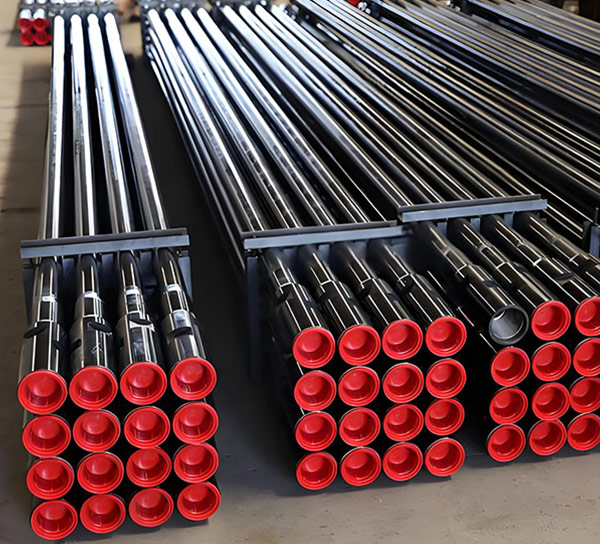
3. Key Risks: Why Mixing Sizes is Discouraged
The significant risks often outweigh the temporary convenience:
- Stress Concentration & Fatigue Failure: The transition point creates a localized stress riser. Under cyclic loads from rotation and bending, especially in long or curved bore paths or hard rock, this junction is prone to fatigue cracks and ultimate failure, risking a downhole string separation.
- Impaired Steering and Accuracy: Different pipe diameters have different flexural stiffness. A mixed string will not bend uniformly, making the tool face harder to control and predict. This compromises steering accuracy and increases the risk of missing the target or hitting utilities.
- Restricted Fluid Flow & Hole Cleaning Issues: A sudden reduction in inner diameter creates a bottleneck, increasing fluid pressure loss and reducing annular velocity. This hinders effective cuttings removal, leading to poor hole cleaning, potential pack-offs, and increased risk of a stuck pipe incident.
4. Practical Guidance: When to Consider, When to Avoid
Based on field experience, here are practical guidelines:
Proceed with Caution (if prerequisites are met):
- Temporary Contingency: For short-distance work (recommended under 50 meters) in urgent situations due to pipe shortages.
- Phase Transition: During reaming/pullback, using a short section of smaller pipe with a sub to connect to a reamer or pullhead.
- Favorable Conditions: In soft, stable formations with low required loads and a relatively straight, shallow bore path.
Strictly Avoid:
- Pilot Hole Drilling: Regardless of geology, to maintain steering precision.
- Long-Radius or Deep Bores: Where cumulative stress and load are high.
- Hard/Rock Formations: Where high torque and shock loads are expected.
- Lacking Proper Equipment: No correctly specified, high-quality, undamaged sub is available, or if pipe/threads are worn or damaged.
5. Standardize When Possible, Proceed with Extreme Caution if Not
The fundamental principle is safety and reliability first. A uniform drill string of matching size and specification is always the best practice for predictable, controlled operations.
Thorough pre-job planning should ensure an adequate inventory of correct pipes. If connecting different sizes is unavoidable, treat it as a controlled exception, not a standard practice. Strict adherence to load ratings, component specifications, and connection procedures is mandatory.
Final Safety Reminder: Always perform a thorough inspection of all tools. Continuously monitor rig parameters (thrust, torque, fluid pressure) during operation. Any abnormal indication requires an immediate stop and investigation to prevent minor issues from escalating into major safety incidents or costly non-productive time.