


What is Horizontal Directional Drilling (HDD)?
Horizontal Directional Drilling (HDD) is a trenchless underground pipeline laying technology. Simply put, it involves drilling a small hole in the ground without excavating the surface, allowing the drill bit to “traverse” underground along a pre-designed route, and finally dragging the pipes, cables, etc., from one end to the other.
If traditional open-cut construction is likened to a major surgery, then horizontal directional drilling is like minimally invasive surgery—small incision, fast recovery, and minimal impact on the surrounding environment.
This technology originated in the oil drilling field, and my country began to participate in it in 1985. After nearly 40 years of development, horizontal directional drilling (HDD) has expanded from a single application to many fields such as municipal water supply and drainage, gas, power and telecommunications, and petrochemicals.
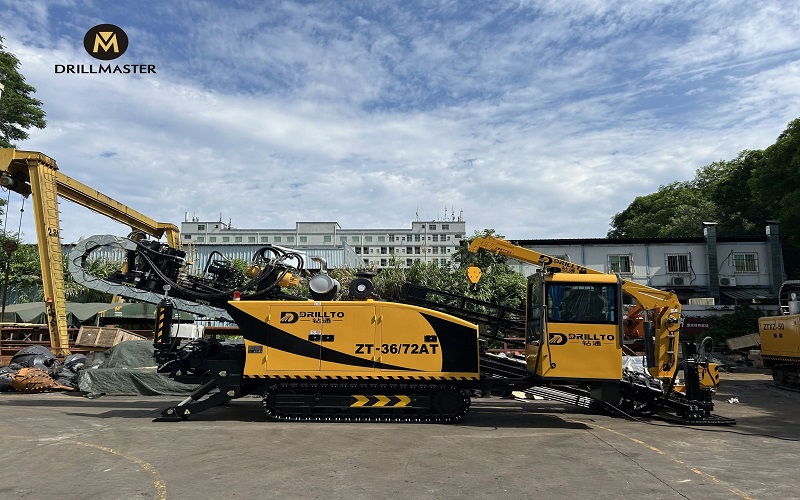
Working Principle of HDD
The working principle of horizontal directional drilling is not complex. Its core is to control the drilling tool through a surface drilling rig to drill a hole underground along a preset trajectory. The entire process is divided into three main stages:
1. Pilot Hole Drilling
This is the first step in the horizontal directional drilling construction process. Using a pilot drill bit and with the assistance of a guiding instrument, construction personnel drill a small-diameter pilot hole along the designed trajectory. The guiding system can acquire parameters such as the depth, inclination angle, and azimuth angle of the drill bit in real time, ensuring that the drill bit moves along the predetermined route. The accuracy of the pilot hole drilling directly determines the success or failure of subsequent construction.
2. Reaming
After the pilot hole is drilled, its diameter is usually much smaller than the final diameter of the pipe to be laid. Therefore, a reamer is needed to enlarge the hole in stages from the exit point to the entry point, gradually increasing the borehole to the required diameter. Generally, the final borehole diameter should reach 1.3 to 1.5 times the outer diameter of the pipe, and then the hole is enlarged stage by stage.
3. Pipe Pullback
Afer the borehole is enlarged to the appropriate size, the drill rod, reamer, pullback joint, and the pipe to be laid are connected sequentially. Starting from the exit point, the pipe is pulled back to the entry point while simultaneously enlarging the borehole. Because the enlarged borehole is filled with mud, the pipe is suspended within the borehole, and the mud lubricates the pipe wall, reducing pullback resistance and protecting the pipe’s corrosion protection layer. At this point, the horizontal directional drilling crossing construction is complete.
Core Equipment for HDD
A complete horizontal directional drilling system mainly includes the following parts:
Drilling Rig System: Provides pushing, pulling, and rotational power; it is the “heart” of the construction.
Power System: Hydraulic pump driven by diesel engine or driving motor
Guidance System (Direction Control System): Real-time monitoring of drill bit position and attitude ensures precise trajectory.
Drill mud system: Supplying mud into the borehole to protect the borehole wall, lubricate, and carry cuttings.
Drill string assembly: Includes drill bit, reamer, drill pipe, etc.
Application Areas of Horizontal Directional Drilling
Horizontal directional drilling has a wide range of applications, covering almost all scenarios requiring underground pipeline laying:
Municipal water supply and drainage: Laying water supply and sewage pipelines
Gas pipelines: Natural gas and coal gas transmission pipelines
Power and telecommunications: Laying power cables and communication optical cables
Petrochemical industry: Long-distance oil and gas pipelines
Water crossing: Crossing rivers, lakes, and straits
Transportation infrastructure crossing: Crossing highways, railways, and airport runways
Seven Core Elements of Horizontal Directional Drilling Advantages
Compared to traditional open-cut methods, HDD offers significant advantages:
No Traffic Obstruction: No road excavation required, ensuring uninterrupted traffic flow.
Environmental Protection:Preserves green spaces, vegetation, and riverbed structure.
High Construction Precision: Allows for precise adjustment of laying direction and depth, bypassing underground obstacles.
Short Construction Cycle: Fast site access and exit, unaffected by seasonal limitations.
Low Overall Cost: Reduces post-construction repair costs, resulting in lower overall project costs.
Safe and Reliable: No underwater or surface work required, ensuring uninterrupted river navigation.
Minimal Social Impact: Does not disrupt residents’ normal lives and work.
In urban pipeline construction, pipeline burial depths typically reach below three meters; when crossing rivers, the burial depth is usually 9-18 meters below the riverbed. Using HDD for crossings has virtually no impact on the surrounding environment.
Horizontal Directional Drilling vs. Pipe Jacking: Which to Choose?
In the field of trenchless technology, HDD and pipe jacking are two of the most common methods. What are the differences between them? How to choose between them?
| Comparison Dimension | Horizontal Directional Drilling | Pipe Jacking |
| Applicable Pipe Diameter | Generally DN1000 and below | Large diameters, mainly for large-diameter sewers and pressure pipelines |
| Applicable Length | Long-distance crossings (several kilometers) | Short to medium distances (typically within 800 m) |
| Geological Adaptability | Suitable for all natural layers (except for obstacles such as pebbles, boulders, and stakes) | Suitable for all natural layers (except for obstacles such as pebbles, boulders, and stakes) |
| Construction Characteristics | Curved alignment, can bypass obstacles | Straight jacking primarily |
In short: For long-distance, small-diameter projects requiring curved routes around obstacles, horizontal directional drilling is preferred; for large-diameter, short-distance projects requiring straight-line jacking, pipe jacking is preferred. Currently, there are very few exceptional cases where 56-inch pipes have been successfully used for WD crossings, but these are rare and require extremely high levels of equipment and technology. If geological conditions are suitable, both methods can be used in combination.
Benchmark Project Cases
In the field of HDD crossing projects, breaking world records often signifies a leap forward in technology and equipment capabilities. Previously, the 5.2-kilometer crossing project at Hong Kong International Airport held the title of “World’s First Crossing” for a long time—this project traversed a rockfill layer, granite, and rock fracture zones at a depth of over 100 meters on the seabed, using pilot-drilled through-hole technology, setting three world records and demonstrating the construction capabilities of Chinese companies under extremely complex geological conditions.
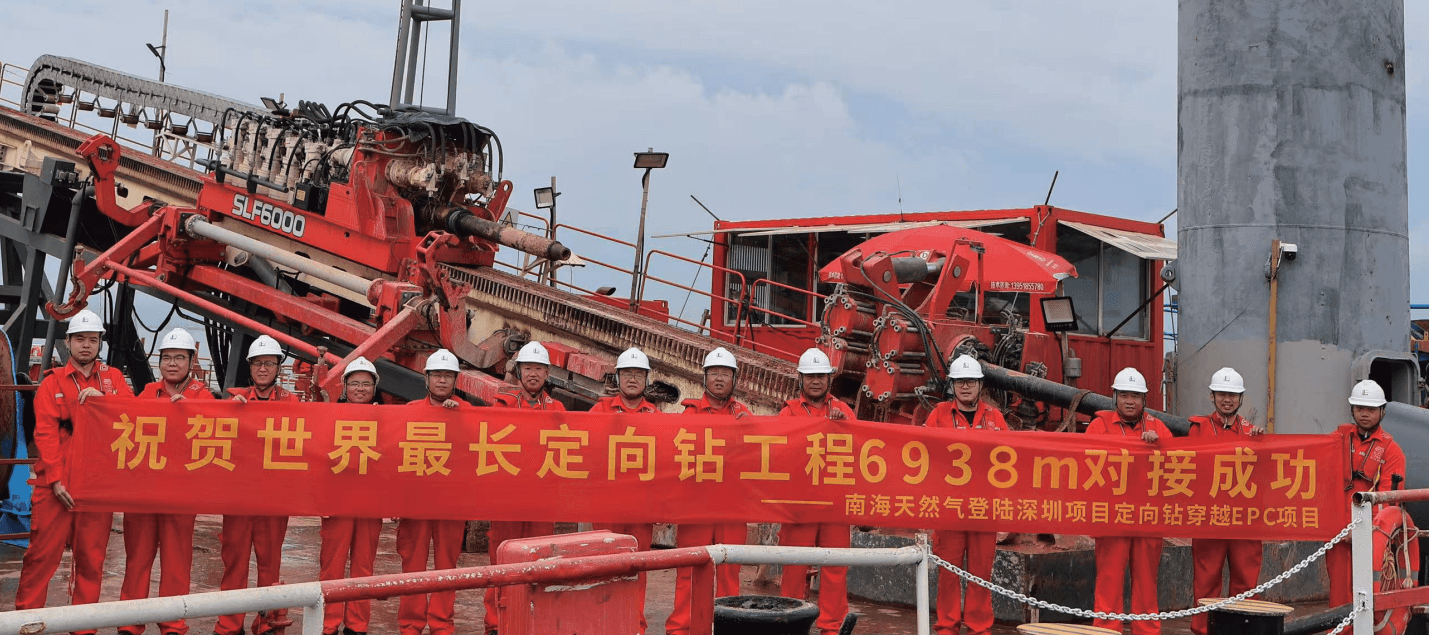
And just recently, on May 31, 2026, this record was rewritten again.
The South China Sea natural gas landing project in Shenzhen—a key energy supply project in Guangdong Province—successfully completed the bidirectional docking of a 6,938-meter-long onshore-offshore directional drilling pilot hole. The drill bits on both sides achieved centimeter-level precision docking 110 meters below the seabed, marking the official birth of the world’s longest directional drilling project.
This project faced numerous challenges, including complex marine hydrological conditions, frequent tidal changes, and a geological structure with alternating hard and soft strata. Ultra-long offshore drilling places extremely high demands on directional accuracy, wellbore stability, and bidirectional docking. The project team achieved this feat through multiple technological innovations.
Behind this leap from 5,200 meters to 6,938 meters lies the solid progress of China’s trenchless technology from “follower” to “leader.” It not only verifies China’s technological maturity in ultra-long-distance onshore-offshore directional drilling but also provides a valuable technological model for future longer-distance, larger-diameter offshore pipeline projects.
Today, China’s horizontal directional drilling technology has gone global, being widely used in countries and regions along the Belt and Road Initiative, such as Iraq and Bangladesh.
Industry Development Trends
The development trends of horizontal directional drilling are mainly reflected in the following directions:
Electrification of Equipment: Electric-driven HDD rigs have been successfully applied in actual projects, possessing advantages such as high efficiency, energy saving, low noise, and fast response.
Intelligent Upgrading: The system control precision and automation level continue to improve.
Breakthroughs in Large Diameter and Long Distance: Technology and equipment capabilities are constantly setting new records.
Expanding Application Scenarios: From land to sea, from land-to-land to land-to-sea.
Horizontal directional drilling trenchless technology can be summarized in one sentence: it allows pipelines to be laid to their desired locations without excavating the ground. From municipal water supply and drainage to long-distance oil and gas transportation, from crossing rivers to crossing straits, this technology is changing the way underground pipelines are constructed. With the continuous improvement of equipment electrification and intelligence, HDD construction will play an increasingly important role in future infrastructure construction.
If you are planning a pipeline project, you might want to learn about HDD crossing construction—it may be a more efficient, economical, and environmentally friendly option than traditional excavation.